The Courage to Be Disliked: Adlerian Psychology for Engineering Teams That Burn Bright and Burn Out
I picked up The Courage to Be Disliked during a turbulent stretch – agentic AI disrupting the industry, layoffs rolling through, genuine uncertainty about the future of software engineering. I was looking for identity anchoring: something to help me know my strengths and weaknesses when the ground keeps shifting. The kind of existential crisis that makes you read philosophy books instead of just updating your LinkedIn to “open to work” like a normal person.
But the book resonated far beyond that. It validated something I’d been struggling with for years and couldn’t name clearly: the burnout that comes from avoiding confrontation and satisfying a vulnerable ego. Not selflessly putting others first – that’s the noble version. The honest version is that I was protecting myself from the discomfort of being disagreed with, of being seen as difficult, of risking disapproval. And the cost of that protection was burning out.
I was diagnosed autistic and ADHD and that reframing changed how I understood my entire career. Decades of masking – performing neurotypical social behaviour to fit in – combined with an absence of self-advocacy. The result is a kind of exhaustion that doesn’t show up on a performance review. You’re delivering. You’re exceeding expectations. And you’re hollowing out.
Most management books didn’t help with this. Even the best ones – Camille Fournier’s The Manager’s Path is the gold standard – assume a baseline of social intuition. “Read the room.” “Build rapport.” “Give feedback naturally.” These are instructions where the how is supposed to be obvious. For a neurotypical manager, maybe it is. For me, it was like a recipe that says “season to taste” when you can’t taste. I spent ten years reading stack traces; now I’m supposed to read rooms. Rooms don’t have error messages. I needed explicit frameworks – logical structures I could study, internalise, and apply deliberately – because I build social skills through acquisition, not instinct.
Adlerian psychology gave me that. Where The Manager’s Path is the operational manual for tech leadership, Adler is the internal operating system that makes executing it sustainable.
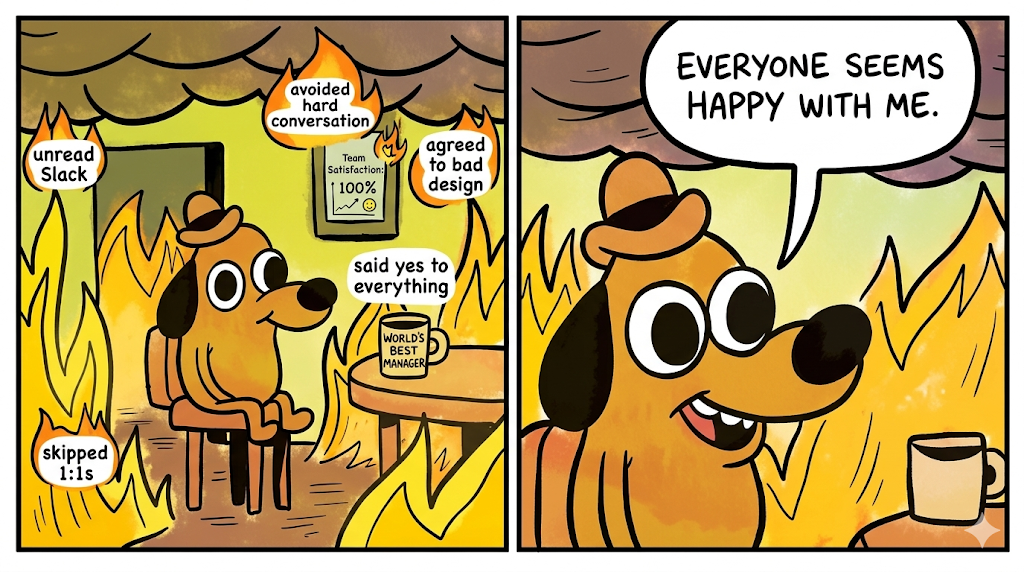
Separation of Tasks: Why Your Engineer’s Career Crisis Is Not Your 2 AM Problem
Adler’s most practical concept is the separation of tasks. The test is simple: who ultimately bears the consequences of this choice?
As a manager:
- Your task: Set clear context. Share relevant experience. Create conditions where the team can make decisions and mistakes safely. Bear organisational consequences.
- Their task: Decide how to approach their work. Learn from their own experience. Own their technical choices. Bear individual consequences.
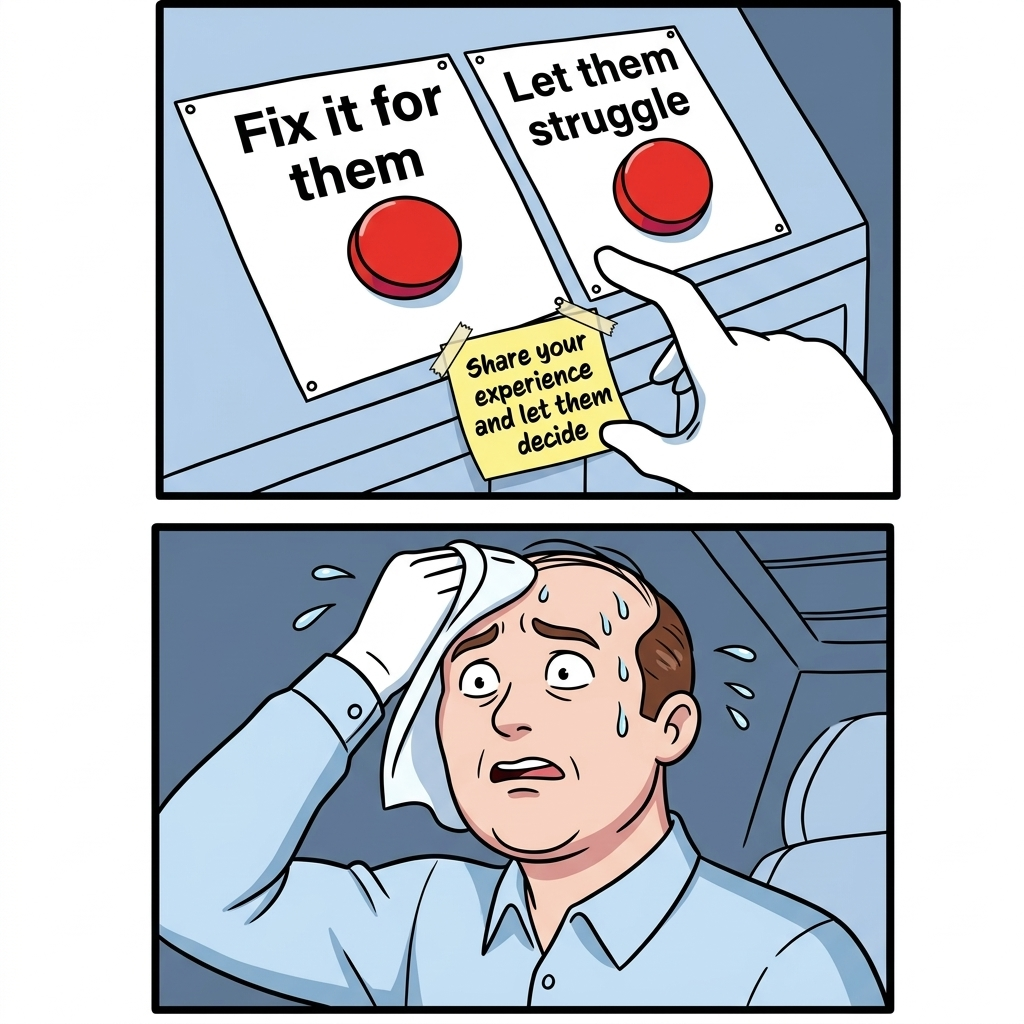
The failure isn’t just micromanagement – stealing their task. It’s also abdication – dumping yours on them. Both are boundary violations.
I once managed an engineer who kept missing deadlines. The work they produced was over-engineered, branching into non-core topics, polished far beyond what was needed. They were visibly exhausted. The technical quality was strong – but the goal kept slipping.
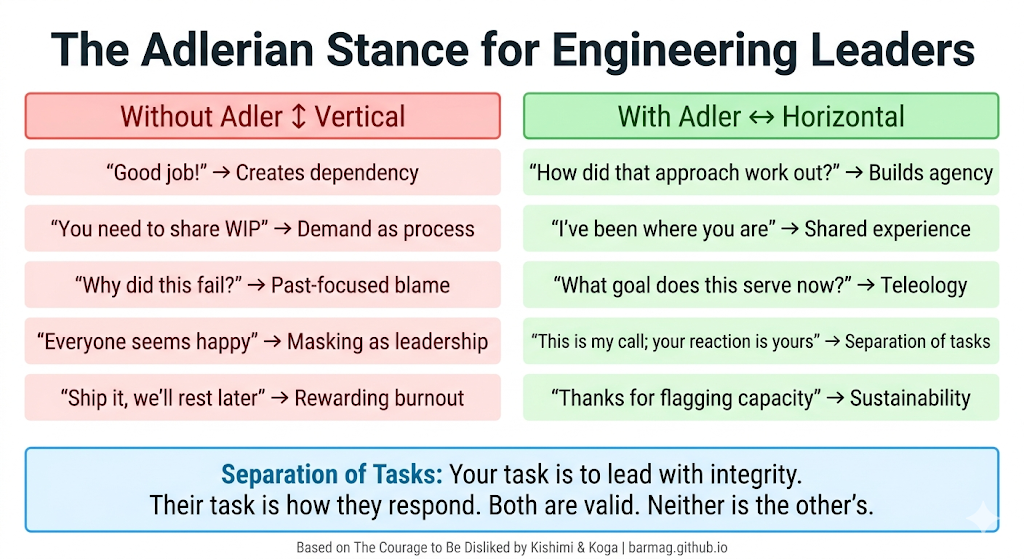
A typical management response: “You need to share your work more frequently. Let’s add checkpoint meetings.” That’s a demand disguised as process. It addresses the symptom by adding control.
I recognised the pattern because I’d lived it. The reluctance to share drafts. The over-engineering as a shield. The logic that says: if I make it perfect enough, no one can criticise it. This wasn’t a performance problem. It was imposter anxiety – avoiding the vulnerability of showing imperfect work. Over-engineering is just anxiety with a GitHub history.
Adler distinguishes between etiology (looking backward at causes) and teleology (looking at what present goal the behaviour serves). The standard management question: “Why are you missing deadlines?” The Adlerian question: “What is this behaviour achieving for you right now?” The answer was safety. The over-engineering served the goal of avoiding judgment.
So instead of adding a demand, I shared my own experience. I talked about times I’d done the same thing – buried myself in perfectionism because showing rough work felt dangerous. I reframed check-ins not as surveillance but as collaborative discovery. The shift was from “you need to show me your work” to “I’ve been where you are, and here’s what helped me.”
The engineer’s behaviour changed. Not because I forced it, but because I made it safe to be imperfect.
Horizontal Relationships: You Have More Mistakes, Not More Worth
You have formal authority over the engineers you manage. That’s organisational reality. But formal authority doesn’t require a vertical relationship.
Adler distinguishes between vertical relationships (superior/inferior, built on judgment) and horizontal relationships (equals, built on mutual respect). Most management instinctively defaults to vertical:
- “I know better than you” (superiority)
- “You should do it this way” (control)
- “Let me show you the right way” (judgment)
The horizontal alternative carries the same experience from a different stance:
- “I’ve made this mistake before” (shared humanity)
- “Here’s what I learned when I tried that” (offering, not imposing)
- “You get to decide how to use this” (respecting agency)
I think of my experience not as “knowing more” but as wisdom from more mistakes. The content is the same. The relationship is completely different.
The word that captures this is offering. When you offer, they can take it or leave it. You’re not diminished if they choose differently. The relationship survives disagreement. Your value isn’t tied to compliance.
Why “Good Job” Turns Engineers Into Golden Retrievers
This plays out most clearly in how you give feedback. Adler argues that praise is a vertical act. When you say “good job,” you’re claiming the authority to judge – positioning yourself above the person you’re evaluating. This creates dependency. Engineers optimise for your approval instead of the work itself. They check in more. They second-guess decisions you haven’t validated. They lose the agency you’re trying to build.
The alternative is encouragement – a horizontal act:
| Praise (vertical) | Encouragement (horizontal) |
|---|---|
| “Good job on the PR” | “I see you tried this approach – how did it work out?” |
| “That’s the right design” | “When I faced something similar, here’s what happened…” |
| “Well done, I’m proud of you” | “Thank you for shipping that quickly – it helped the team hit our deadline” |
If your team’s primary feedback loop is your facial expressions, you’ve built a distributed system with a single point of failure.
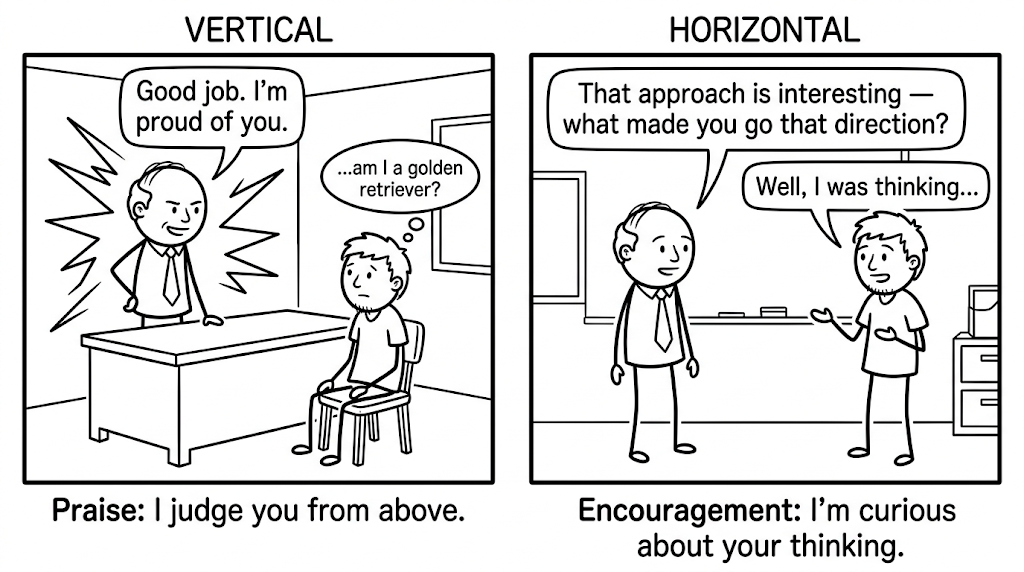
The difference between “I evaluate your work” and “I’m curious about your thinking” is where psychological safety actually lives. Not the performative kind where everyone is polite. The kind where engineers feel safe being wrong.
The Desire for Recognition: A Performance Review of My Own Ego
Adler denies the desire for recognition. His argument: if you live seeking others’ approval, you end up living someone else’s life.
This is where the neurodivergent experience and the management problem converge. Before I had Adler’s framework, I didn’t recognise that my conflict avoidance as a manager wasn’t good leadership. It was masking — protecting a vulnerable ego from the discomfort of confrontation and the risk of disapproval.
The research documents this pattern precisely. Raymaker et al. (2020) found that autistic burnout is characterised by chronic exhaustion, loss of skills, and reduced tolerance to stimulus — distinct from occupational burnout, and strongly correlated with masking and unmet support needs. Hull et al. (2017) documented the cost of camouflaging: socially effective but psychologically destructive. Mantzalas et al. (2022) showed how late-diagnosed adults accumulate years of compensatory strategies that eventually collapse. This isn’t abstract to me. This is my career in my twenties and thirties.
In a management context, masking looks like: agreeing with decisions you disagree with, avoiding hard conversations, letting poor dynamics persist because addressing them means risking being seen as difficult. It looks like competence. It feels like drowning.
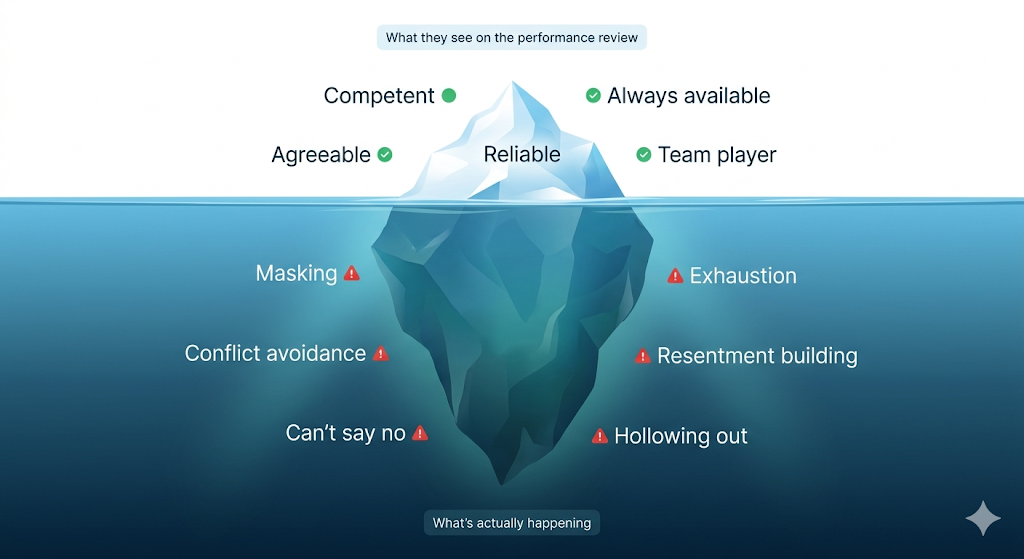
Adler’s separation of tasks broke this cycle for me. Their reaction to my decision is their task. My task is to make the decision with integrity and communicate it clearly. I cannot control how they feel about it – and trying to is both a violation of their autonomy and a path to hollowing out.
This gave me permission to self-advocate. To say no. To have the difficult conversation and let their response be theirs.
But permission to speak isn’t the same as knowing how. Adler tells you that you should have the courage to be disliked – he doesn’t tell you how to deliver the message without being an arsehole. That’s where three other books filled the gap for me:
- Radical Candor (Kim Scott) gave me the framework of caring personally while challenging directly. The courage to be disliked doesn’t mean being indifferent – it means being honest because you care, not despite it.
- Radical Respect (Kim Scott) added the boundary between candour and harm. Being direct is not the same as being cruel. You can separate tasks without dismissing the person.
- Nonviolent Communication (Marshall Rosenberg) gave me the actual mechanics: observe without evaluating, name the need, make a request instead of a demand. For someone who builds social skills through deliberate acquisition, NVC was the API documentation I’d been missing.
Together, these form a stack: Adler gives you the philosophical permission. Radical Candor gives you the stance. NVC gives you the syntax. Without all three, you either stay silent (burnout) or speak without skill (damage).
The Harder Problem: Stopping Good Engineers From Setting Themselves on Fire
The harder problem in managing high-performing engineers isn’t motivation. It’s preventing burnout in people who are passionate, skilled, and willing to destroy themselves shipping great work.
Performance management frameworks are designed to address underperformance. But what do you do with an engineer who’s delivering brilliantly and burning out doing it?
I learned this from my own experience first. I burned out not because I was pushed, but because I didn’t advocate for my own needs. I confused the organisation’s task (maximising output) with mine (sustainable contribution). Adler helped me see the distinction.
As a manager, the same framework applies:
- The engineer’s task: Own their sustainability. Set boundaries. Decide when to push and when to rest.
- The manager’s task: Create conditions where sustainability is possible. Model it. Make “I’m at capacity” a respected signal, not a weakness.
You can take a horse to water, but you can’t make it drink. You can build an environment where rest is valued and pace is designed for endurance. But you cannot force someone to take care of themselves. That’s their task.
What you can do is stop rewarding self-destruction. Stop celebrating the engineer who ships at 2 AM. No one has ever said “I’m so glad I shipped that feature at 2 AM on a Sunday” at their own funeral. Start thanking the one who flags a risk early and asks for help. The incentives you set shape the behaviour the team optimises for.
What I Took Away
Adlerian psychology didn’t give me a management framework. It gave me a different stance from which to apply whatever framework I already use:
- Separate tasks. Know what’s yours and what’s theirs. Don’t steal their agency; don’t abdicate yours.
- Stay horizontal. You have authority over their role, not their worth. Lead from shared experience, not superiority.
- Encourage, don’t praise. Be curious about their thinking instead of evaluating their output.
- Let go of the need for approval. Make the right call. Let their reaction be their task.
- Protect the team from burnout. The harder problem isn’t pushing people to perform – it’s making it safe to stop.
For neurotypical managers, some of this may come naturally. For me – decades of masking behind me, a history of burning out while exceeding expectations – it required deliberate construction. Adler gave me what intuition-based management advice never could: an explicit, logical framework for leading people without losing myself in the process.
The courage to be disliked isn’t about not caring. It’s about caring enough to be honest – with your team, and with yourself – even when the honest thing is unpopular.
For anyone who has spent years performing competence while quietly exhausting themselves: that’s not leadership. That’s survival. And you deserve a better operating system.
And if reading an Adlerian psychology book seems like an unusual path to becoming a better engineering manager – well, so did reading the Kubernetes docs, and we all did that.
Based on The Courage to Be Disliked by Ichiro Kishimi & Fumitake Koga. Companion reading: The Manager’s Path by Camille Fournier, Radical Candor by Kim Scott, Radical Respect by Kim Scott, and Nonviolent Communication by Marshall Rosenberg.
Research cited: Raymaker et al. (2020), “Having All of Your Internal Resources Exhausted Beyond Measure and Being Left with No Clean-Up Crew: Defining Autistic Burnout”. Hull et al. (2017), “Putting on My Best Normal: Social Camouflaging in Adults with Autism Spectrum Conditions”. Mantzalas et al. (2022), “What Is Autistic Burnout? A Thematic Analysis of Posts on Two Online Platforms”.